
Performance That Improves Over Time
Artificial Intelligence is accelerating how organizations operate. Processes are faster, information is abundant, and decisions are expected in real time. Across industries, companies are investing heavily in automation and advanced tools. Yet the real challenge is not technological. It is strategic.
As roles evolve, workflows shift, and customer expectations continue to change, the key question is no longer how to introduce AI into the business. The real question is whether the organization itself is designed to adapt, learn, and improve continuously.
In the age of AI, competitive advantage will not come from access to technology. It will come from adaptability and performance.
From Static Solutions to Adaptive Performance
For decades, organizations designed operations, workplaces, and systems as fixed solutions expected to deliver stable performance over time. Today, that model no longer holds. Business environments change too quickly, and technologies evolve faster than traditional investment cycles.
Future-ready organizations must function as adaptive systems. They need the ability to integrate new tools without disruption, adjust to changing collaboration patterns, and respond to new market conditions while maintaining strategic alignment.
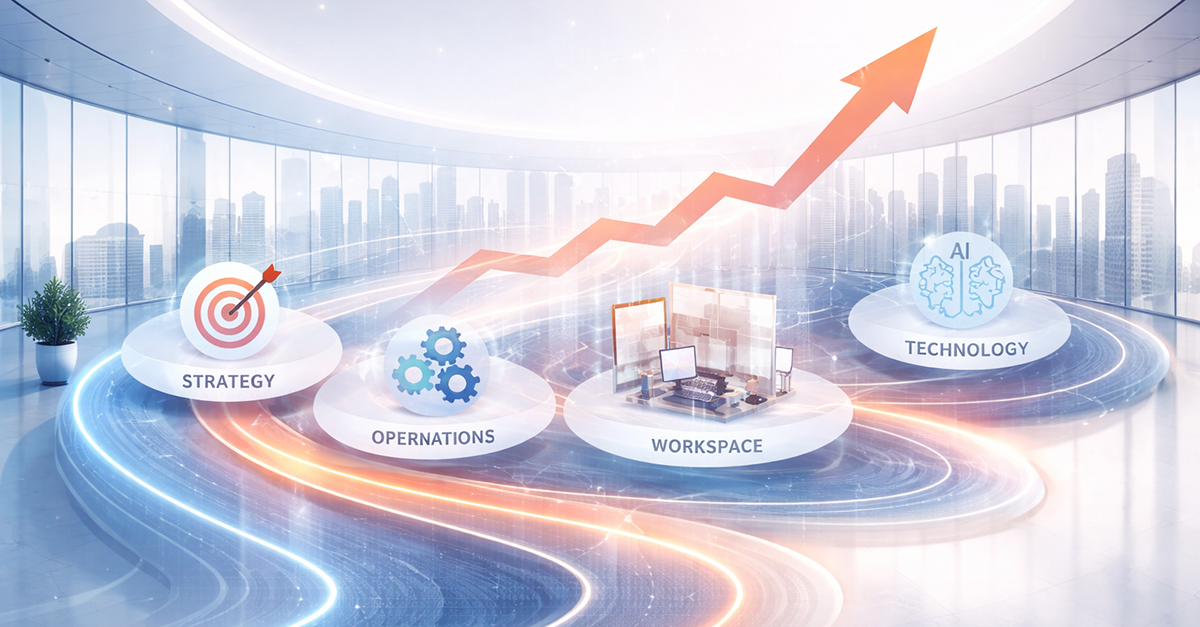
Strategy supports this shift by moving beyond one-time solutions to frameworks that allow organizations to evolve while aligning operations, space, and technology with business strategy.
Speed Requires Direction
AI delivers efficiency, automation, and scale. It reduces operational effort and increases the speed at which information can be processed. However, speed alone does not create value.
Without clear priorities and governance, organizations risk generating more activity without improving outcomes. Faster decisions can lead to inconsistency. Increased output can dilute focus. Technology, when applied without strategic intent, amplifies complexity rather than performance.
“The real value of AI is not speed. It is the ability to improve decision quality at scale.”
Strategy ensures that automation accelerates what matters, defining where AI creates operational advantage and where human judgment must remain central to business performance and customer value.
Designing Investments That Appreciate
The most important shift introduced by AI is the need for systems that improve over time. Skills evolve, tools change, and ways of working are continuously refined. Yet many operational structures and workplaces are still treated as assets that gradually lose relevance.
Organizations now need environments and processes designed to increase their value. This requires identifying where change is most likely and building adaptability into those areas, while maintaining stability where consistency supports performance. By connecting operational and behavioral data, companies can understand what works, what does not, and where targeted adjustments will deliver measurable impact.
This approach transforms workplaces and operations into high-performing, adaptable business assets rather than depreciating ones.
Human Value in an Automated World
As automation expands, human contribution shifts toward areas that require context, judgment, and synthesis. Strategic thinking, problem-solving, creativity, and relationship management become the primary sources of differentiation.
Organizations must therefore reduce operational noise and create conditions for deeper thinking and better decision-making. Strategy supports this by removing friction where speed is required and preserving focus where reflection and collaboration drive innovation, alignment, and growth.
Strategy in a Changing Operating Reality
The organizations that will lead in the AI era will not be those with the most advanced tools. They will be those designed to learn, adapt, and align technology with business performance.
This marks an evolution in the role of strategy, from shaping spaces and experiences to designing adaptive, performance-driven business systems that integrate intelligence, guide decisions, and remain effective as change accelerates.
At STIRIXIS Group, this direction is reinforced through the development of AI culture and operational capability, ensuring that technology strengthens performance and supports the delivery of True Prosperity™ for our clients.
Because in the end, the advantage will not belong to the organizations that implement AI faster, but to those designed to become better every year.
Explore how STIRIXIS strategy aligns innovation, operations, and environments to improve performance over time.
For inquiries or to discuss how these principles apply to your organization, contact us at advance@stirixis.com.
